

If you run a business in Malaysia, you've probably heard about Scope 1,2, and 3 emissions — the three categories used to measure a company's carbon footprint. They may sound technical, but they are becoming part of everyday Malaysian business requirements.
With Bursa Malaysia introducing mandatory ESG reporting from 2025, companies of all sizes — even non-listed SMEs — are starting to feel the impact. Understanding your emissions is now key to staying compliant, winning tenders, and maintaining your competitiveness.
In short: When you know your carbon footprint, you make better business decisions, stay ahead of requirements, and show your stakeholders you are serious about sustainability.

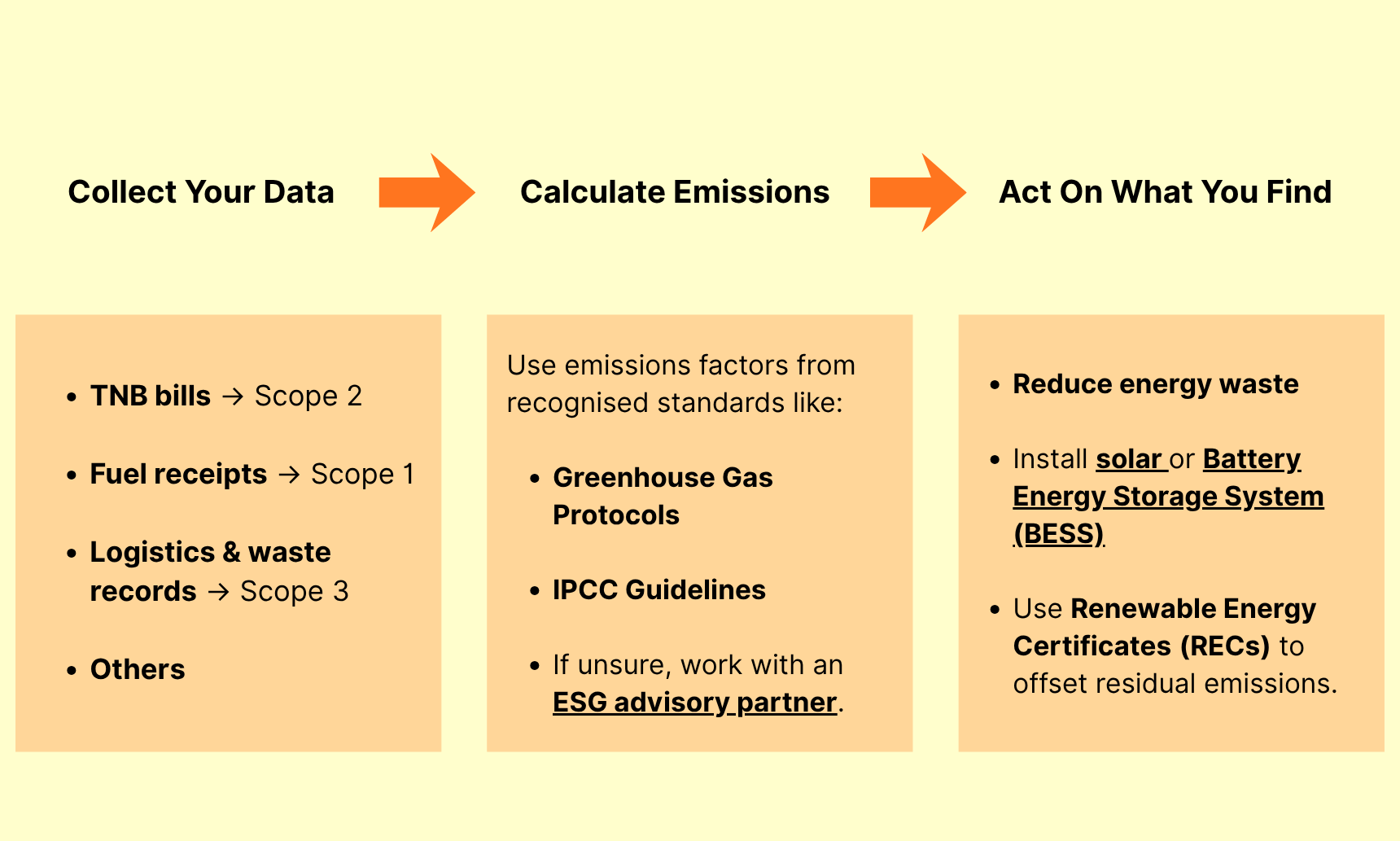
Definition: Direct greenhouse-gas (GHG) emissions from sources you own or control.
Examples:
These are the easiest to measure because they're under your control — your fleet, your site, your equipment.
Definition: Indirect greenhouse-gas (GHG) emissions from the energy you purchase — mainly electricity from Tenaga Nasional Berhad (TNB).
Examples:
Even though the emissions happen at TNB's power plants, your company is responsible for the electricity you consume.

Scope 3 covers all other indirect emissions across your entire value chain — both upstream (suppliers) and downstream (customers).
Examples:
For most organisations, Scope 3 is the largest and most difficult to measure, but it's also where the biggest opportunity lie.

1. Bursa Malaysia Now Requires ESG Reporting: Starting FY2025, listed companies must prepare sustainability disclosures in line with IFRS S1 and IFRS S2 (ISSB Standards) as announced by Bursa Malaysia on 23 Dec 2024. Companies must begin climate-related disclosures from FY2025 with full compliance by 2027.
2. Pressure on SMEs via the Supply Chain: Large corporations now need data from suppliers to complete their value-chain (Scope 3) reporting. This means they will request information such as:
If you cannot provide this, you may risk losing contracts, tender, or vendor qualification.
3. Access to Financing and Incentives: Banks increasingly favour companies with verified ESG metrics. Having emissions data strengthens your eligibility for:
Q1 — Is Scope 3 mandatory in Malaysia?
Not yet. But large companies will need it by 2027, and many are already collecting supplier data today.
Q2 — Do SMEs need to report now?
Formally: No requirement yet. Practically: Yes; If your client needs Scope 3 data, you will need supply it — or risk losing the business with them.
Q3 — How does this link to Malaysia's Net Zero Goal?
Under the National Energy Transition Roadmap (NETR) Malaysia aims for net-zero emissions by 2050. Tracking Scope 1,2,3 is the first step toward that goal.

Early movers will:
Carbon reporting is becoming as normal as financial reporting — the question is when, not if.

Shift helps Malaysian businesses map, measure, and manage their carbon emissions:
Ready to get started? Reach out to Shift by Sunview to future-proof your business and demonstrate real climate progress in Malaysia.
Disclaimer: For informational purposes only. See professional advice for your company's specific ESG needs.